↑
  • HAL Typefaces
  • Collection
  • Licensing
  • Notes
  • About
  • Trial Fonts
  • Collection
  • Licensing
  • Notes
  • About
  • Trial Fonts
Four GroteskGapMagicMatexRepostTimezoneColantTwins
  • © 2026 HAL Typefaces
  • Newsletter
  • Cookies & Privacy
  • Magic
  • High
  • Mid
  • Low
  • Variable
  • Features
  • Glyphs
  • Info
  • In Use

Overview

Magic High
Thin Thin Oblique
Light Light Oblique Regular Regular Oblique
Medium Medium Oblique Bold Bold Oblique
Heavy Heavy Oblique
Magic Mid
Thin Thin Oblique
Light Light Oblique Regular Regular Oblique
Medium Medium Oblique Bold Bold Oblique
Heavy Heavy Oblique
Magic Low
Thin Thin Oblique
Light Light Oblique Regular Regular Oblique
Medium Medium Oblique Bold Bold Oblique
Heavy Heavy Oblique
Variable

High

Size
 
Features
Genies

Features

Glyphs

▼Basic Characters
▼Punctuation
▼Circled Figures
▼Language Extension
▼Fractions and Ordinals
▼Superscript and Subscript
▼Currency and Math
▼Arrows and Symbols

Info

Description

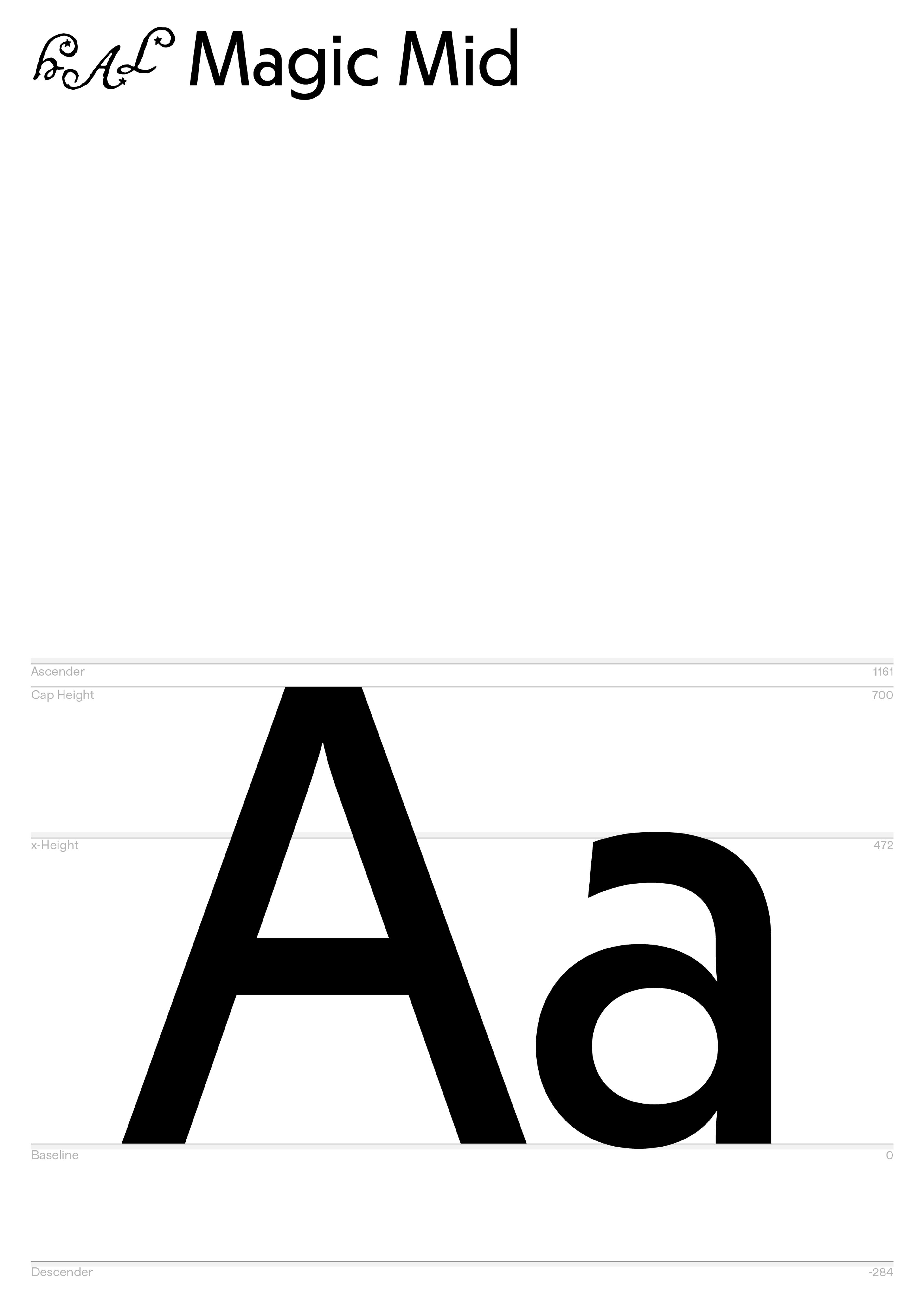
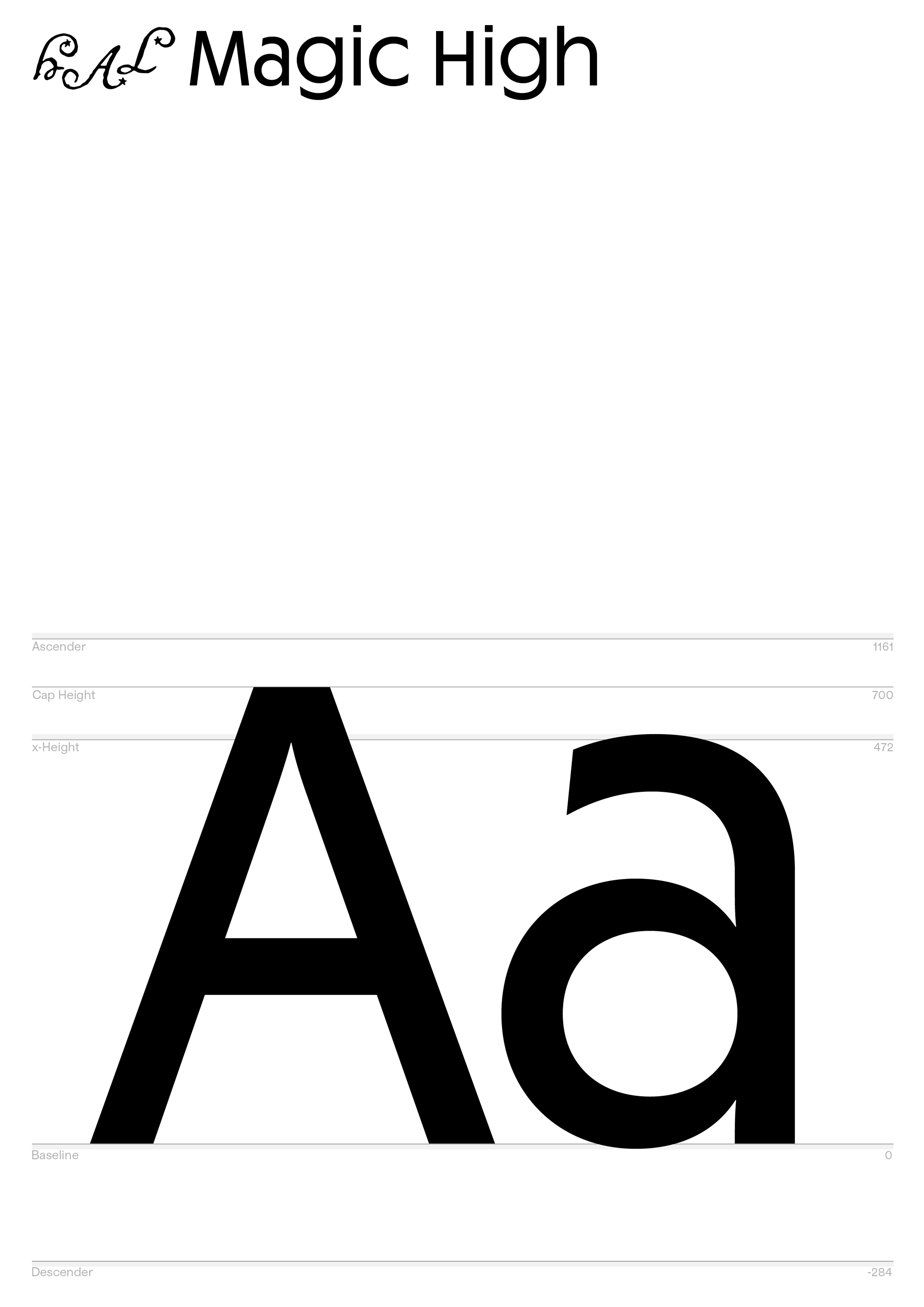
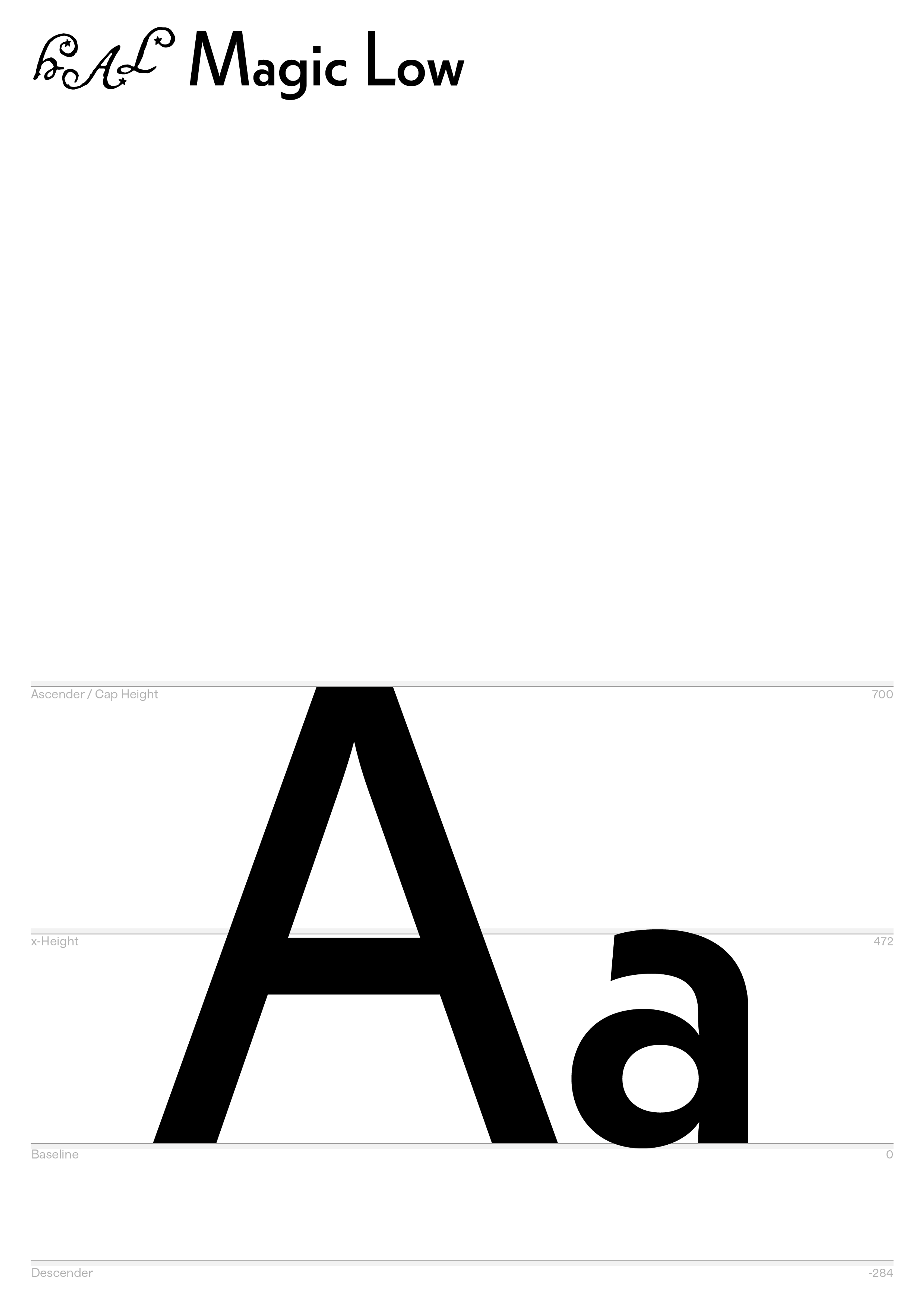
HAL Magic is a true entertainer with some special tricks up its sleeve. The typeface comes in three families with variant x-heights: High, Mid and Low. Each family brings its own distinct flavour and contains six weights plus corresponding obliques. All of these states are included in a spellbinding variable font, which allows for fluid transitions and enchanted shapeshifting. Rely on Magic to get the job done and make it look extremely easy.

Credits

Design: HAL Typefaces
Production: HAL Typefaces with Alex Lescieux
Volume: 3 families, 36 styles, VF
File Formats: otf, ttf, woff, woff2
Release Year: 2025
Spacing/Kerning: Igino Marini

Supported Languages

Abron, Abua, Acheron, Achinese, Acholi, Achuar-Shiwiar, Adamawa Fulfulde, Adangme, Afar, Afrikaans, Aguaruna, Ahtna, Akoose, Alekano, Aleut, Alonquin, Amahuaca, Amarakaeri, Amis, Anaang, Andaandi, Dongolawi, Angas, Anufo, Anuta, Arabela, Aragonese, Arbëreshë Albanian, Asháninka, Ashéninka Perené, Asturian, Atayal, Awa-Cuaiquer, Awing, Baatonum, Bafia, Bagirmi Fulfulde, Balante-Ganja, Balinese, Balkan Romani, Bambara, Banjar, Baoulé, Bari, Basque, Bassari, Batak Dairi, Batak Karo, Batak Mandailing, Batak Simalungun, Batak Toba, Bemba (Zambia), Bena (Tanzania), Biali, Bikol, Bini, Bislama, Boko (Benin), Bomu, Bora, Borana-Arsi-Guji Oromo, Borgu Fulfulde, Bosnian, Breton, Buginese, Bushi, Candoshi-Shapra, Caquinte, Caribbean Hindustani, Cashibo-Cacataibo, Cashinahua, Catalan, Cebuano, Central Aymara, Central Kurdish, Central Nahuatl, Central-Eastern Niger Fulfulde, Cerma, Chachi, Chamorro, Chavacano, Chayahuita, Chiga, Chiltepec Chinantec, Chokwe, Chuukese, Cimbrian, Cofán, Cook Islands Māori, Cornish, Corsican, Creek, Crimean Tatar, Croatian, Czech, Danish, Dehu, Dimli, Duala, Dutch, Dyan, Dyula, Eastern Arrernte, Eastern Maninkakan, Eastern Oromo, Efik, English, Fanti, Faroese, Fijian, Filipino, Finnish, French, Friulian, Ga, Gagauz, Galician, Ganda, Garifuna, German, Gheg Albanian, Gilbertese, Gonja, Gooniyandi, Gourmanchéma, Guadeloupean Creole French, Gusii, Haitian, Hani, Hassaniyya, Hausa, Hawaiian, Hiligaynon, Hopi, Huastec, Hungarian, Hän, Ibibio, Icelandic, Idoma, Igbo, Iloko, Inari Sami, Indonesian, Irish, Istro Romanian, Italian, Ixcatlán Mazatec, Jamaican Creole English, Javanese, Jenaama Bozo, Jola-Fonyi, K’iche’, Kabuverdianu, Kaingang, Kako, Kala Lagaw Ya, Kalaallisut, Kalenjin, Kamba (Kenya), Kaonde, Kaqchikel, Kara-Kalpak, Karelian, Kashubian, Kekchí, Kenzi, Mattokki, Khasi, Kikuyu, Kimbundu, Kinyarwanda, Kirmanjki, Kituba (DRC), Kom (Cameroon), Kongo, Konzo, Koyraboro Senni Songhai, Krio, Kven Finnish, Kölsch, Ladin, Ladino, Latgalian, Lingala, Lithuanian, Lombard, Low German, Lower Sorbian, Lozi, Luba-Lulua, Lule Sami, Luo (Kenya and Tanzania), Luxembourgish, Maasina Fulfulde, Macedo-Romanian, Madurese, Makonde, Malagasy, Malaysian, Maltese, Mam, Mamara Senoufo, Mandinka, Mandjak, Mankanya, Manx, Maore Comorian, Maori, Mapudungun, Marshallese, Matsés, Mauritian Creole, Mende (Sierra Leone), Meriam Mir, Meru, Metlatónoc Mixtec, Mi’kmaq, Minangkabau, Mirandese, Mizo, Mohawk, Montenegrin, Munsee, Murrinh-Patha, Murui Huitoto, Muslim Tat, Mwani, Ménik, Mískito, Naga Pidgin, Ndonga, Neapolitan, Ngazidja Comorian, Nigerian Fulfulde, Niuean, Nobiin, Nomatsiguenga, Noon, North Azerbaijani, North Marquesan, North Ndebele, Northern Kissi, Northern Kurdish, Northern Qiandong Miao, Northern Sami, Northern Uzbek, Norwegian, Nyamwezi, Nyanja, Nyankole, Nyemba, Nzima, Occitan, Ojitlán Chinantec, Orma, Oroqen, Otuho, Palauan, Pampanga, Papantla Totonac, Papiamento, Paraguayan Guaraní, Pedi, Picard, Pichis Ashéninka, Piemontese, Pijin, Pintupi-Luritja, Pipil, Pite Sami, Pohnpeian, Polish, Portuguese, Potawatomi, Pulaar, Purepecha, Páez, Quechua, Romanian, Romansh, Rotokas, Rundi, Saafi-Saafi, Samoan, Sango, Sangu (Tanzania), Saramaccan, Sardinian, Scots, Scottish Gaelic, Sena, Seri, Seselwa Creole French, Sharanahua, Shawnee, Shilluk, Shipibo-Conibo, Shona, Shuar, Sicilian, Silesian, Slovak, Slovenian, Soga, Somali, Soninke, South Azerbaijani, South Marquesan, South Ndebele, Southern Aymara, Southern Bobo Madaré, Southern Dagaare, Southern Qiandong Miao, Southern Sami, Southern Sotho, Spanish, Sranan Tongo, Standard Estonian, Standard Latvian, Standard Malay, Sundanese, Susu, Swahili, Swedish, Swiss German, Syenara Senoufo, Tagalog, Tahitian, Talysh, Tedim Chin, Tetum, Tetun Dili, Timne, Tiéyaxo Bozo, Toba, Tok Pisin, Tokelau, Tonga (Tonga Islands), Tonga (Zambia), Tosk Albanian, Tsakhur, Tumbuka, Turkish, Turkmen, Tuvalu, Twi, Tzeltal, Tzotzil, Uab Meto, Umbundu, Ume Sami, Upper Guinea Crioulo, Upper Sorbian, Venetian, Veps, Vietnamese, Vlax Romani, Võro, Wallisian, Walloon, Walser, Wamey, Waray (Philippines), Warlpiri, Wasa, Wayuu, Welsh, West Central Oromo, West-Central Limba, Western Abnaki, Western Frisian, Western Niger Fulfulde, Wiradjuri, Wolof, Xhosa, Yagua, Yanesha’, Yao, Yoruba, Yucateco, Zapotec, Zarma, Zulu, Zuni, Záparo
Typeface in use
PDF Specimen
Magic Low
Typeface in use
PDF Specimen
Magic Mid
Typeface in use
PDF Specimen
Magic High

In Use

magic
magic
magic
magic
magic
magic
magic

Wanderer zwischen den Welten Design by Studio HanLi, 2024

Related Notes

Size
 
Features
Coney Island
Size
 
Features
Paranormal Activity Not Yet Detected
Size
 
Features
Big Zoltar
Size
 
Features
Marvins Marvelous Mechanical Museum is an arcade and museum previously located in Farmington Hills, Michigan. It features a large collection of vintage arcade games and other coin-operated entertainment machines, most of which are functional and can be operated by visitors. Exhibits include the gypsy Fortune teller machine that used to feature in many carnival sideshows. As of January 2025, Marvins is temporarily closed for relocation; it is expected to reopen in its new location in West Bloomfield, Michigan in the summer of 2025. Marvins Marvelous Mechanical Emporium was founded by Marvin Yagoda, a pharmacist who collected, restored, and sold antique arcade machines. Yagoda initially housed his collections in his garage, but at the suggestion of his wife, he installed some of his machines in the food court of the Tally Hall shopping center in Farmington Hills, Michigan in the early 1980s. He later rented a space in the mall until it closed in 1988 and reopened after it was rebuilt as Orchard Lake Plaza (now known as Hunters Square) in 1990.Yagoda became a recognized expert in the field of mechanical and electrical game apparatus; he has been involved in appraisal of such items for the television series American Pickers. He died on January 8, 2017, at the age of 78, after which his son, Jeremy, assumed control of the museum.
Size
 
Features
Sházàm!
Size
 
Features
Hermetic Astrology Babylonian Stargazers Milky Neutron
Size
 
Features
Snakes Apple
Size
 
Features
The Young Magicians Club’s principal means of communication among its members is its bi-monthly magazine Secrets. The worldwide membership also communicates through a members-only on-line forum on the Young Magicians Club website. Membership in The Young Magicians Club requires no interview or exam and is open to all young people interested in magic. There are monthly all-day workshops for members who come from all over the country to take part. Adult members of The Magic Circle take on the responsibility of instructing the members of the Young Magicians Club. Local adult magic clubs will often have a junior magicians club attached to them but The Young Magicians Club is the only such club associated with The Magic Circle. Members of the Young Magicians Club are eligible to join The Magic Circle at a reduced rate when they reach 18, but then they must complete the examination procedure for full membership. The Young Magicians Club holds their annual one-day convention every October called “J-Day”. The convention includes lectures and the finals of two competitions with awards, which include the Home Counties Trophy for stage magic, The Mark Leveridge Cup for close-up magic, Kaymar Komedy Cup and the Peter McCahon Award for Originality. In recent years, the celebrity guest lectures have been presented by Derren Brown in 2010, Dynamo in 2011, John Archer in 2012, Marvin Berglas in 2013, Luis De Matos in 2014 and Dave Loosley and Andi Gladwin in 2015. The popularity of the Harry Potter franchise was one of the key reasons for the organisation’s growth this century with membership doubling after the announcement of the first film in 2001.
Size
 
Features
Quartz Crystal Ball
Size
 
Features
Rig Chance
Size
 
Features
Memory

Mid

Size
 
Features
Kingsley Rising 1986 Four Burglars Balducci Levitation
Size
 
Features
Now Trance
Size
 
Features
Lunar cycles were being noted as early as 25,000 years ago.This was a first step towards recording the Moon’s influence upon tides and rivers, and towards organising a communal calendar. Farmers addressed agricultural needs with increasing knowledge of the constellations that appear in the different seasons—and used the rising of particular star-groups to herald annual floods or seasonal activities. By the 3rd millennium BCE, civilisations had sophisticated awareness of celestial cycles, and may have oriented temples in alignment with heliacal risings of the stars. Scattered evidence suggests that the oldest known astrological references are copies of texts made in the ancient world. The Venus tablet of Ammisaduqa is thought to have been compiled in Babylon around 1700 BCE. A scroll documenting an early use of electional astrology is doubtfully ascribed to the reign of the Sumerian ruler Gudea of Lagash (c. 2144 – 2124 BCE). This describes how the gods revealed to him in a dream the constellations that would be most favourable for the planned construction of a temple. However, there is controversy about whether these were genuinely recorded at the time or merely ascribed to ancient rulers by posterity. The oldest undisputed evidence of the use of astrology as an integrated system of knowledge is therefore attributed to the records of the first dynasty of Babylon (1950–1651 BCE). This astrology had some parallels with Hellenistic Greek (western) astrology, including the zodiac, a norming point near 9 degrees in Aries, the trine aspect, planetary exaltations, and the dodekatemoria (the twelve divisions of 30 degrees each). The system of Chinese astrology was elaborated during the Zhou dynasty (1046–256 BCE) and flourished during the Han dynasty (2nd century BCE to 2nd century CE), during which all the familiar elements of traditional Chinese culture – the Yin-Yang philosophy, theory of the five elements, Heaven and Earth, Confucian morality – were brought together to formalise the philosophical principles of Chinese medicine and divination, astrology, and alchemy.The ancient Arabs that inhabited the Arabian Peninsula before the advent of Islam used to profess a widespread belief in fatalism (ḳadar) alongside a fearful consideration for the sky and the stars, which they held to be ultimately responsible for every phenomena that occurs on Earth and for the destiny of humankind.
Size
 
Features
Coinfold
Size
 
Features
Neutron Supernova (Diffused Folks) Uncapturred Beauty
Size
 
Features
3,762 Words
Size
 
Features
Lunar cycles were being noted as early as 25,000 years ago.This was a first step towards recording the Moon’s influence upon tides and rivers, and towards organising a communal calendar. Farmers addressed agricultural needs with increasing knowledge of the constellations that appear in the different seasons—and used the rising of particular star-groups to herald annual floods or seasonal activities. By the 3rd millennium BCE, civilisations had sophisticated awareness of celestial cycles, and may have oriented temples in alignment with heliacal risings of the stars. Scattered evidence suggests that the oldest known astrological references are copies of texts made in the ancient world. The Venus tablet of Ammisaduqa is thought to have been compiled in Babylon around 1700 BCE. A scroll documenting an early use of electional astrology is doubtfully ascribed to the reign of the Sumerian ruler Gudea of Lagash (c. 2144 – 2124 BCE). This describes how the gods revealed to him in a dream the constellations that would be most favourable for the planned construction of a temple. However, there is controversy about whether these were genuinely recorded at the time or merely ascribed to ancient rulers by posterity. The oldest undisputed evidence of the use of astrology as an integrated system of knowledge is therefore attributed to the records of the first dynasty of Babylon (1950–1651 BCE). This astrology had some parallels with Hellenistic Greek (western) astrology, including the zodiac, a norming point near 9 degrees in Aries, the trine aspect, planetary exaltations, and the dodekatemoria (the twelve divisions of 30 degrees each). The system of Chinese astrology was elaborated during the Zhou dynasty (1046–256 BCE) and flourished during the Han dynasty (2nd century BCE to 2nd century CE), during which all the familiar elements of traditional Chinese culture – the Yin-Yang philosophy, theory of the five elements, Heaven and Earth, Confucian morality – were brought together to formalise the philosophical principles of Chinese medicine and divination, astrology, and alchemy.The ancient Arabs that inhabited the Arabian Peninsula before the advent of Islam used to profess a widespread belief in fatalism (ḳadar) alongside a fearful consideration for the sky and the stars, which they held to be ultimately responsible for every phenomena that occurs on Earth and for the destiny of humankind.
Size
 
Features
Age❺Babylon
Size
 
Features
Sunlight
Size
 
Features
Eleanor Catton & Times The Luminary World Karlson’s Spiral Dancing
Size
 
Features
The Hermit?
Size
 
Features
Sparkling Rules

Low

Size
 
Features
Fortune-Telling
Size
 
Features
King Lear
Size
 
Features
Paradiso Coma
Size
 
Features
Millennium Lunar Cycles
Size
 
Features
Marvins Marvelous Mechanical Museum is an arcade and museum previously located in Farmington Hills, Michigan. It features a large collection of vintage arcade games and other coin-operated entertainment machines, most of which are functional and can be operated by visitors. Exhibits include the gypsy Fortune teller machine that used to feature in many carnival sideshows. As of January 2025, Marvins is temporarily closed for relocation; it is expected to reopen in its new location in West Bloomfield, Michigan in the summer of 2025. Marvins Marvelous Mechanical Emporium was founded by Marvin Yagoda, a pharmacist who collected, restored, and sold antique arcade machines. Yagoda initially housed his collections in his garage, but at the suggestion of his wife, he installed some of his machines in the food court of the Tally Hall shopping center in Farmington Hills, Michigan in the early 1980s. He later rented a space in the mall until it closed in 1988 and reopened after it was rebuilt as Orchard Lake Plaza (now known as Hunters Square) in 1990.Yagoda became a recognized expert in the field of mechanical and electrical game apparatus; he has been involved in appraisal of such items for the television series American Pickers. He died on January 8, 2017, at the age of 78, after which his son, Jeremy, assumed control of the museum.
Size
 
Features
Zhou Dynasties
Size
 
Features
Ionization 24/7 Metaphysical Halo Crystal Healing & Aura-soma Nuclear Evolution: Rainbow Body Bioenergetic Analysis Esc.
Size
 
Features
Houston Astros
Size
 
Features
Lunar cycles were being noted as early as 25,000 years ago.This was a first step towards recording the Moon’s influence upon tides and rivers, and towards organising a communal calendar. Farmers addressed agricultural needs with increasing knowledge of the constellations that appear in the different seasons—and used the rising of particular star-groups to herald annual floods or seasonal activities. By the 3rd millennium BCE, civilisations had sophisticated awareness of celestial cycles, and may have oriented temples in alignment with heliacal risings of the stars. Scattered evidence suggests that the oldest known astrological references are copies of texts made in the ancient world. The Venus tablet of Ammisaduqa is thought to have been compiled in Babylon around 1700 BCE. A scroll documenting an early use of electional astrology is doubtfully ascribed to the reign of the Sumerian ruler Gudea of Lagash (c. 2144 – 2124 BCE). This describes how the gods revealed to him in a dream the constellations that would be most favourable for the planned construction of a temple. However, there is controversy about whether these were genuinely recorded at the time or merely ascribed to ancient rulers by posterity. The oldest undisputed evidence of the use of astrology as an integrated system of knowledge is therefore attributed to the records of the first dynasty of Babylon (1950–1651 BCE). This astrology had some parallels with Hellenistic Greek (western) astrology, including the zodiac, a norming point near 9 degrees in Aries, the trine aspect, planetary exaltations, and the dodekatemoria (the twelve divisions of 30 degrees each). The system of Chinese astrology was elaborated during the Zhou dynasty (1046–256 BCE) and flourished during the Han dynasty (2nd century BCE to 2nd century CE), during which all the familiar elements of traditional Chinese culture – the Yin-Yang philosophy, theory of the five elements, Heaven and Earth, Confucian morality – were brought together to formalise the philosophical principles of Chinese medicine and divination, astrology, and alchemy.The ancient Arabs that inhabited the Arabian Peninsula before the advent of Islam used to profess a widespread belief in fatalism (ḳadar) alongside a fearful consideration for the sky and the stars, which they held to be ultimately responsible for every phenomena that occurs on Earth and for the destiny of humankind.
Size
 
Features
Nineteen Eighty-Four
Size
 
Features
Stellar Time
Size
 
Mass Times Energy

Variable


Sign Up to the HAL Newsletter

Bird running with a letterBird running with a letter
Bird holding a letterBird holding a letter